






Information on Recycled Water in Macao
Last updated: 06/03/2026
(1) Recycled Water Information Booth
- Marine and Water Bureau (DSAMA) works with The Macao Water Supply Company Limited (Macao Water) and several associations, on setting up “Recycled Water Information Booths” in the supply zones of recycled water, to promote recycled water to the community. The exhibition runs from 17 January to 29 April 2026.
- During the following time slots, staff are available to provide information about recycled water and answer enquiries.
|
Location |
Date |
Time |
|
Leisure Area at Block 3, Lok Kuan Building, Seac Pai Van |
17 January, 25 January, 8 February, 22 February, 1 March, 2 March, 8 March, 11 March, 14 March, 29 March, 12 April, 26 April |
14:00-17:00 |
|
Booth E4 of the University of Macau |
17 January, 2 February, 27 February, 3 March, 26 March, 10 April |
(2) Recycled Water Promotion Day
- DSAMA, together with Macao Water and local associations, is hosting the “Recycled Water Promotion Day” on 28 February 2026, 14:00-17:30, to introduce the public to the applications of recycled water through interactive and engaging activities.
- A recycled water session, “Water Saving Superhero” drama, booth games and fun workshops are available on site. Participants are entitled to receive a variety of attractive prizes.


IV. Brief Introduction to Recycled Water
- Recycled water refers to the sewage that has undergone advanced treatment and can be used for non-potable purposes, such as toilet flushing and landscape irrigation.
- The utilisation of recycled water enables the recycling of precious water resources while reducing the demand for raw water supplied from the mainland to Macao.

V. Supply Zones, Timeline and Uses
(1) Recycled Water Supply Zones and Timeline
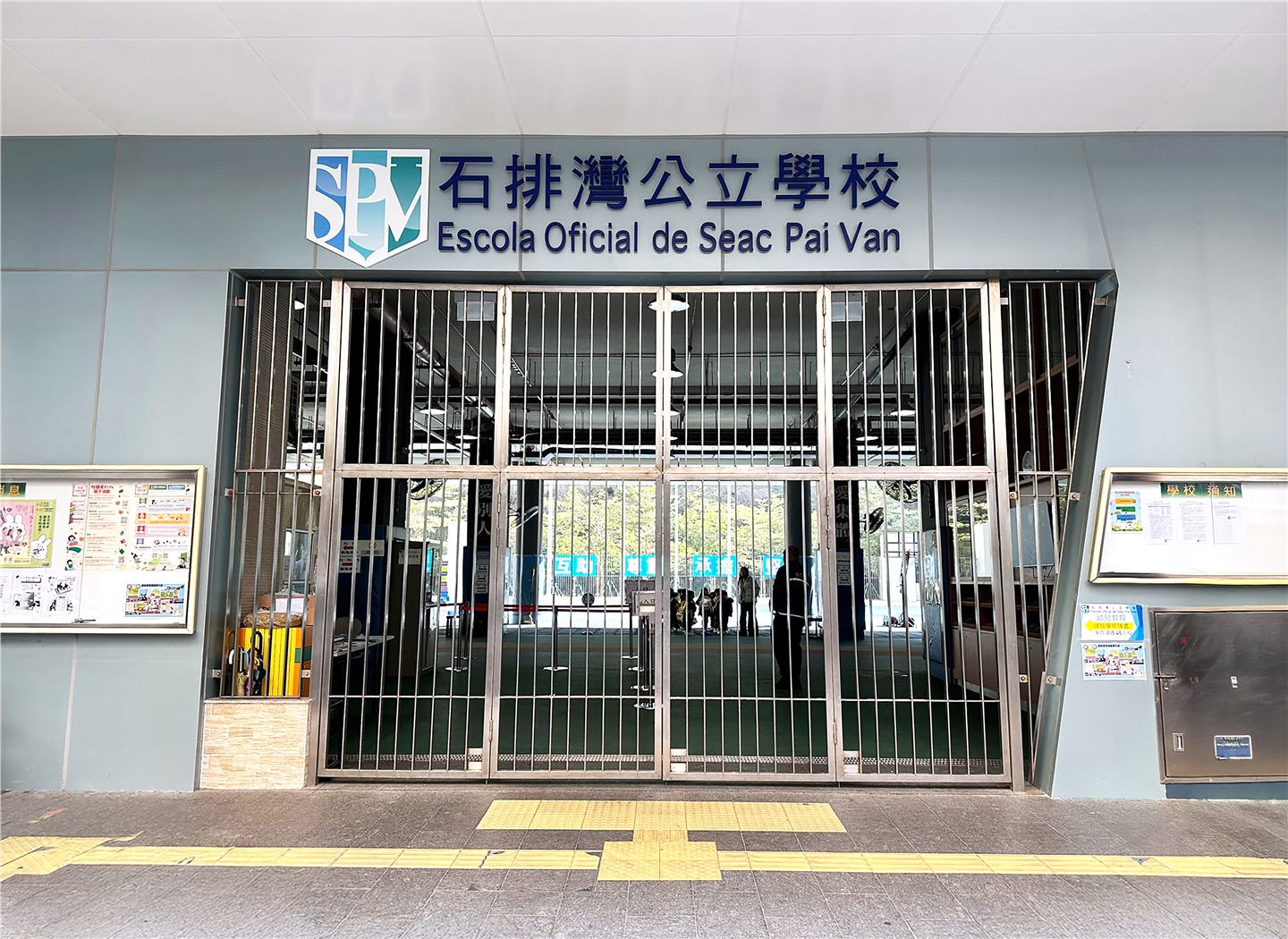
- Starting from 1 March 2026, recycled water is supplied to the buildings equipped with a dual pipe system in the Seac Pai Van public housing complex and the University of Macau, for toilet flushing and landscape irrigation.
|
Seac Pai Van Public Housing Complex * |
Koi Nga Building, Lok Kuan Building, Ip Heng Building, Seac Pai Van Public School, Language Teaching Activity Centre, Vocational Technical Education Activity Centre, Seac Pai Van Community Complex, Seac Pai Van Social and Health Services Building |
|
University of Macau |
University of Macau, Hengqin Island Operation Station of Fire Services Bureau, Public Security Police Force - University of Macau New Campus Station |
* On Son Building, constructed earlier without a dual pipe system, does not meet the conditions for recycled water supply. Recycled water is supplied to both residential and commercial users of Koi Nga, Lok Kuan and Ip Heng Building.
- Considering that the recycled water pipeline network serves as the primary infrastructure for water supply, Macao's existing old urban areas lack the space and conditions to add new pipelines. Therefore, the supply of recycled water will primarily be concentrated in areas already equipped with a dual pipe system and in newly developed urban zones, with phased implementation planned for the future. Recycled water in these areas will be supplied by two stations, located on the Hong Kong-Zhuhai-Macao Bridge Artificial Island and in Coloane.

(2) Uses of Recycled Water
- In the initial phase, recycled water will be used for toilet flushing and landscape irrigation purposes.
- As technology matures and conditions permit, exploring additional applications for recycled water will be considered to conserve precious freshwater resources.
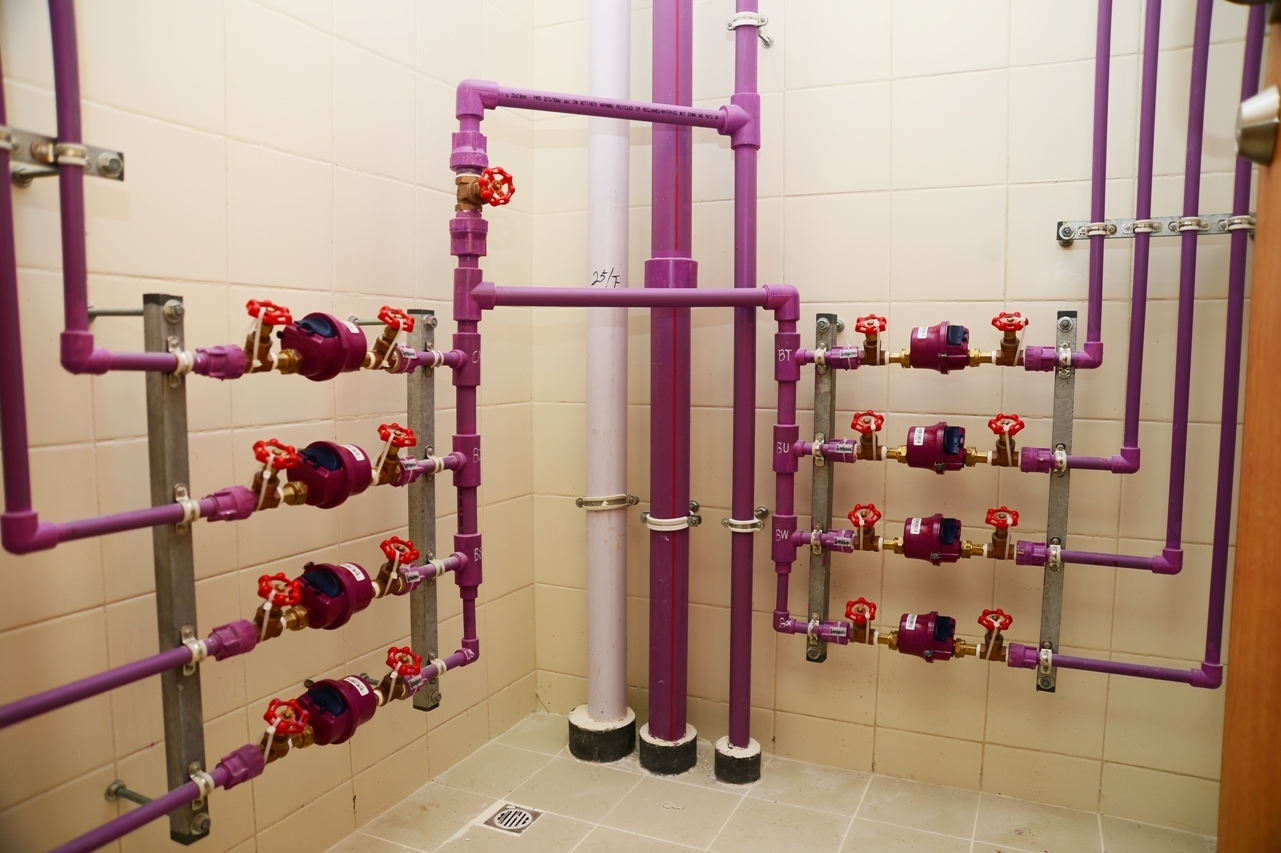
In order to prevent cross-connection of recycled water pipes in residential buildings, recycled water pipes are coloured differently from drinking water pipes.
| Comparison between recycled water pipes and drinking water pipes in buildings | ||
| Type of Pipes | Recycled Water Pipes | Drinking Water Pipes |
| Colour | Purple | White, silver grey, brass etc. |
VII. Quality of Recycled Water
Recycled water is colourless and odourless. The criteria of recycled water quality are established in accordance with The use of urban recycling water – Water quality standard for urban miscellaneous use of National Standards of the People’s Republic of China (GB/T18920-2020). The parameters of recycled water quality include indicators such as microorganisms and disinfection so as to satisfy hygiene and safety requirements. Macao Water conducts recycled water quality tests every day and announces the results (link), ensuring it is safe and hygiene.
| Table of comparison between the major parameters of non-conventional water used for toilet flushing in different regions | ||||
| Water quality parameters | Seawater for toilet flushing in Hong Kong |
Recycled Water of Macau | Non-potable water of Mainland China | Recycled water of Hong Kong |
| Residual Chlorine | Not regulated | ≥1.0mg/L | ≥1.0mg/L | ≥0.5mg/L |
| Turbidity | <20NTU | ≤ 5NTU | ≤ 5NTU | ≤ 2NTU |
| Escherichia coli | <5000cfu/100ml | Non-detectable | Non-detectable | Non-detectable |
(1) Pricing Principle
- Water is a precious resource. Recycled water users are required to pay for it, adhering to the principle of “Users pay”.
- Recycled water tariff is 85% of that of drinking water.
(2) Categorised Pricing
- Recycled water tariff is based on the categorised tariff in the drinking water tariff system. The recycled water tariff for each category of recycled water consumers is calculated upon the drinking water tariff in the respective category whereas domestic recycled water consumers are billed for their recycled water charges, based on the first tier of tariff in the domestic category.
- The water bill itemises both the consumption and amount of drinking water and recycled water, allowing consumers to make a single payment for the total amount, with no additional applications required.
(1) Water Shortage
- Macao suffers from water shortages. A majority of Macao’s raw water comes from the Xijiang River and is transported from Zhuhai to Macao. In recent years, the raw water from Zhuhai to Macao has accounted for up to 98% of Macao’s raw water.
- Due to global climate changes, the upstream of Xijiang River has experienced droughts for three years consecutively from 2020 to 2022. Meanwhile, the demand for water arising from social development, hydroelectric power, shipping and logistics, agricultural irrigation, ecological and environmental protection in the Xijiang River basin has also increased constantly. The Xijiang River is experiencing growing pressures for water demand. Furthermore, with the completion of the Pearl River Delta Water Resources Allocation Project and the Northern Bay Water Resources Allocation Project entering the construction phase, the Xijiang River—as the primary water source for these two major initiatives—is encountering increasingly significant demand pressure on its water resources.
- To ensure Macao’s water supply security, in addition to relying on strong support from the nation, Macao also needs to enhance water recycling and build a water‑saving society.
- Therefore, the Macao SAR Government is actively promoting the application of recycled water.
(2) National and Macao Water Resources Planning
- The SAR Government needs to adhere to the national water conservation priority policy and water security assurance plan, strengthening the recycling of water resources.
- In December 2020, the "Water Security Assurance Plan for the Guangdong-Hong Kong-Macao Greater Bay Area" proposed to increase the development of unconventional water sources and incorporate them into the unified allocation of regional water resources. It also emphasized accelerating the renovation and construction of urban sewage and recycling facilities, prioritising the use of recycled water in areas such as urban greening. By 2035, the utilisation of unconventional water sources in the nine cities of the Pearl River Delta is expected to account for more than 10% of the total water supply.
- In January 2022, the "14th Five-Year Plan for Water Security Assurance" proposed strengthening the diversified, tiered, and safe utilisation of unconventional water sources such as recycled water in water-scarce areas, incorporating wastewater resource utilisation as a key aspect of water conservation and source development.
- The "Second Five-Year Plan for Economic and Social Development of the Macao Special Administrative Region (2021-2025)" proposes promoting resource recycling and reuse. It aims to introduce recycled water applications and construct recycled water treatment facilities in New Urban Zone A and artificial island.
Conditions for Macao Recycled Water Application and Objectives
- At present, Macao’s sewage treatment and collection systems are well-developed, creating favourable preconditions for wastewater recycling and facilitating the implementation of recycled water application in Macao.
- The SAR Government supplies recycled water based on the actual needs of different regions and development stages, and gradually expands the water supply capacity of recycled water stations in response to changing demand over time.
- To promote the application of recycled water in a long-term and effective manner, the SAR Government has established medium and long-term objectives for recycled water usage.
- In the future, after the completion of various new urban zones, the medium-term objective (by 2030) for recycled water application is for recycled water usage to account for over 5% of Macao’s total water consumption, while the long-term one (by 2035) is for it to exceed 10% of total water consumption.
The primary infrastructure of the recycled water system includes recycled water stations and pipeline networks. Since the recycled water supplied by these stations comes from wastewater treatment plants, it is planned to construct one recycled water station next to the Coloane Wastewater Treatment Plant and another next to the Hong Kong-Zhuhai-Macao Bridge Artificial Island Wastewater Treatment Plant.
(1) Recycled Water Stations
- The Coloane Recycled Water Station will be constructed in two phases. The first phase, with a water supply capacity of 2,500 cubic meters per day, will be completed and operational in the first quarter of 2026, supplying water to the Seac Pai Van Public Housing Complex and the University of Macau. After the completion of the second phase, the water supply capacity of the Coloane Recycled Water Station will increase to 15,000 cubic meters per day. The timing of its water supply operations will align with the progress of the Coloane Wastewater Treatment Plant upgrade project. In addition to serving the Seac Pai Van Public Housing Complex and the University of Macau, the water supply area will expand to the Avenida Wai Long and the Cotai area. In the future, both the Artificial Island and Coloane Recycled Water Stations will be able to expand their water supply capacities based on the demand for recycled water.
- The Artificial Island Recycled Water Station will have a water supply capacity of 25,000 cubic meters per day. The timing of its water supply operations will align with the progress of the Artificial Island Wastewater Treatment Plant construction project. The water supply area will include the Artificial Island, New Urban Zones A, B, C, D, E, and the temporary housing in P-Lot of Areia Preta.
(2) Recycled Water Pipeline Network
- Developed urban areas generally lack the conditions for adding new recycled water supply facilities. Therefore, the installation of recycled water pipelines focuses primarily on newly reclaimed lands and development zones near recycled water stations.
- The overall recycled water pipeline network will adopt a looped layout and will be interconnected between the Artificial Island and Coloane Recycled Water Stations via pipelines laid along routes such as the Macao Bridge. The pipeline installation will proceed in a phased manner. The first phase has already completed the pipeline network connecting the Coloane Recycled Water Station to the existing dual pipe system in the Seac Pai Van community and the University of Macau. Currently, pipeline installation is being carried out in coordination with road construction in New Urban Zone A. It is projected that by 2035, the total length of the recycled water pipeline network will exceed 100 kilometers.
1. What is recycled water?
A: Recycled water refers to the sewage that has undergone advanced treatment and can be used for non-potable purposes. In the initial phase, recycled water is primarily used for toilet flushing and landscape irrigation.
2. Will there be a recycled water supply in the old urban areas?
A: The supply of recycled water will primarily be concentrated in areas already equipped with a dual pipe system and in newly developed urban zones.
3. Is recycled water a substitute for drinking water?
A: At the current stage, recycled water is limited to uses such as toilet flushing and irrigation, thus only partially substituting for drinking water. The application of recycled water helps conserve drinking water and safeguards Macao's water supply security.
4. Is recycled water safe?
A: The water quality of recycled water and recycled water is identical—both are colourless and odourless. The water quality standards for both are established with reference to the National Standard of the People's Republic of China, "The Reuse of Urban Recycling Water—Water Quality Standard for Urban Miscellaneous Water Consumption" (GB/T 18920-2020), which includes parameters such as microbial and disinfection indicators. Macao Water conducts daily testing to ensure that the quality of recycled water meets hygiene requirements.
5. Is recycled water charged?
A: Yes. Recycled water is metered and charged separately. Recycled water tariff is 85% of that of drinking water.
6. How to prevent recycled water from flowing into the drinking water pipes?
A: Recycled water pipes and drinking water pipes are made of different materials. The colour of recycled water pipes is also distinct from that of tap water pipes, and the pipes are marked with warning labels. Users should hire qualified plumbers to inspect, install, and maintain both drinking water and recycled water pipes in their homes to avoid incorrect connections.
7. Why is it necessary to develop the application of recycled water?
A: The vast majority of the raw water required by Macao comes from mainland China. With socio-economic development and population growth, Macao's demand for water resources will continue to rise. The SAR Government must enhance the level of water resource recycling to ensure Macao's long-term water supply security.
8. Can recycled water be used for cleaning and other purposes?
A: It is not recommended to use recycled water for purposes other than toilet flushing and landscape irrigation.
9. Are the recycled water stations located close to residential areas? Will they give off any odours?
A: Both the Coloane Recycled Water Station and the Artificial Island Recycled Water Station are situated at a certain distance from residential areas. The quality of the recycled water complies with the National Standard of the People's Republic of China, "The Reuse of Urban Recycling Water—Water Quality Standard for Urban Miscellaneous Water Consumption" (GB/T 18920-2020), and will not cause sensory discomfort or produce any odours.
10. If accidentally exposed to recycled water, will it cause illness?
A: The quality of recycled water in Macao meets all hygiene and safety requirements. Residents will not contract illnesses from contact with recycled water.
11. Will recycled water and drinking water be billed separately?
A: No. The water bill for recycled water users will specify the consumption of both drinking water and recycled water, as well as the total amount due. Users can pay for both types of water fees in a single transaction.
12. Do households in the recycled water supply area need to sign an updated contract with Macao Water before the water supply begins?
A: No, recycled water users do not need to complete any additional procedures.
